Athera News
Clinical Safety
Fast-Tracking Surgical Kit Is a Symptom, Not a Solution
When a theatre coordinator calls to request urgent turnaround on an instrument set, the decontamination team’s responsiveness is a genuine mark of the professionalism that characterises these departments. But fast-track has a cost that is rarely quantified, and a cause that is rarely examined. This article explores both.
Why fast-track requests are often demonstrative of an operational oversight
At Royal United Hospitals Bath NHS Foundation Trust, Deputy Decontamination Manager Dave Lockyer describes a scenario familiar to most decontamination professionals: “The SSD get calls from theatres asking for kit which SSD had sent 3 days prior.”
The instrument set in question had been processed, verified, and dispatched, but because its location beyond the point of dispatch wasn’t known to the theatre team making the call, the request was treated as urgent and escalated accordingly.
This means that the decontamination team was asked to prioritise something that had already been completed.
This is one of the most common drivers of unnecessary fast-track requests, and it connects directly to the theme explored in Article 3 of this series: When traceability ends at dispatch, theatre teams have no mechanism to confirm whether processed equipment is already available.
In the absence of that visibility, the default response is to assume unavailability and request urgent processing. The resulting fast-track request is not a reflection of genuine clinical urgency but a reflection of a data gap.
When fast-track becomes routine
The visibility gap explains one category of unnecessary fast-track, but there is a second pattern that data analysis surfaces with similar regularity:
In many departments, fast-track has shifted from an exception to a default and used so routinely that it no longer functions as an escalation mechanism but as a standard method of managing demand.
This pattern is not visible at the individual request level, because each individual request arrives framed as urgent and is treated as such. It only becomes visible when fast-track data is reviewed in aggregate across a period of time and mapped against standard turnaround time records.
(Are you noticing a pattern here? Data viewed in aggregate is so much more powerful than individual data points coming in)
When that analysis is done, departments regularly find that a significant proportion of fast-track requests were made for instruments whose standard turnaround time would have met the clinical need, had the request come through the normal planning process.
The implications of that finding are significant. Every unnecessary fast-track request that jumps the processing queue displaces other instrument sets further down the line, places additional pressure on staff managing an already demanding workflow, and introduces the kind of reactive urgency that creates conditions for error.
But how do we fix it?
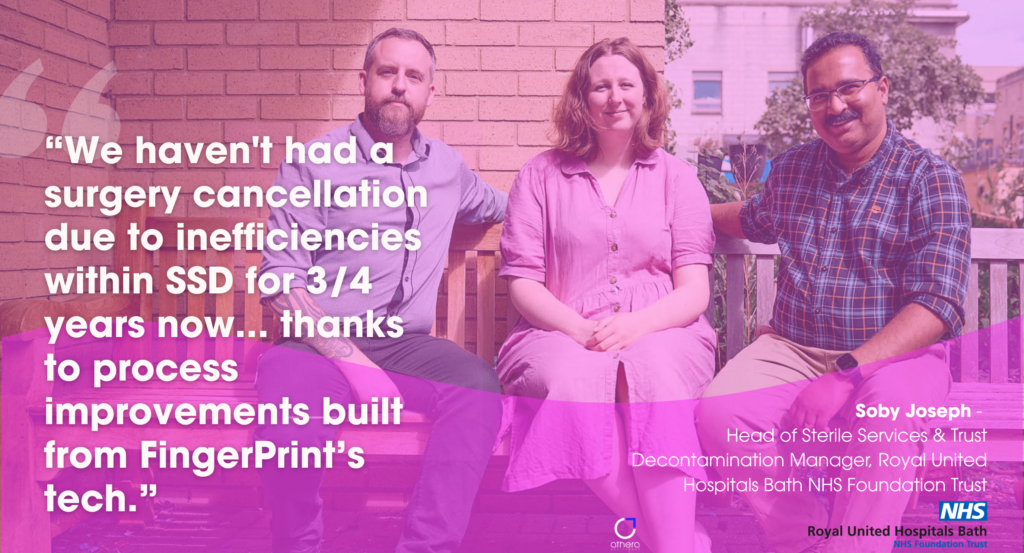
At Royal United Hospitals Bath NHS Foundation Trust, the combination of real-time traceability, improved cross-departmental visibility, and process improvements built from data contributed to an outcome that speaks directly to the patient safety argument at the heart of this series. Soby Joseph, Head of Sterile Services and Trust Decontamination Manager, states: “We haven’t had a surgery cancellation due to inefficiencies within SSD for 3/4 years now, because the SSD team knows exactly what’s happening now thanks to process improvements built from FingerPrint’s tech.”
That outcome is the result of a department that understood where its data gaps were, addressed the visibility failures that were driving unnecessary pressure, and built a planning process that reduced the conditions under which reactive fast-track requests arise.
The same principle applies to fast-track analysis more broadly. Departments that review fast-track frequency against turnaround time data, dispatch records, and theatre request patterns gain a clear picture of where genuine urgency ends and habitual escalation begins. That clarity makes it possible to reduce unnecessary fast-track in a way that is evidence-led rather than simply a request for theatre teams to plan better.
Is fast-track frequency in your department worth examining?
For decontamination managers and sterile services leads reviewing their own practice, a few questions are worth considering.
When a fast-track request arrives, is there a mechanism to check whether the equipment has already been processed and dispatched before the request is actioned? If the answer is no, the scenario Dave Lockyer describes at RUH (calls for kit that left the department three days prior) is likely a regular occurrence.
Has fast-track frequency been reviewed against standard turnaround time data? If fast-track requests are a daily occurrence across multiple instrument types, the question of whether all of them reflect genuine urgency is worth asking. The data to answer it is almost certainly already being captured.
And finally, what conversations are possible with theatre teams when fast-track usage is supported by data rather than anecdote? The difference between asking theatres to plan better and showing them that a significant proportion of their fast-track requests were for instruments already available in stores is the difference between a difficult conversation and a productive one.
Alex Prior is Head of Sales at Athera Healthcare, working with NHS Sterile Services and Endoscopy Reprocessing departments across the UK and Ireland. If you would like to discuss your department’s traceability setup, you can reach Alex directly here.
Book a Demo
Arrange a one-to-one demonstration with a member of our dedicated team. We collaborate to tailor the experience so you can see how our solutions can be applied in your specific context and utilised effectively to achieve your objectives.