Behind the Mask
What it Takes to Become a Centre of Excellence in Decontamination
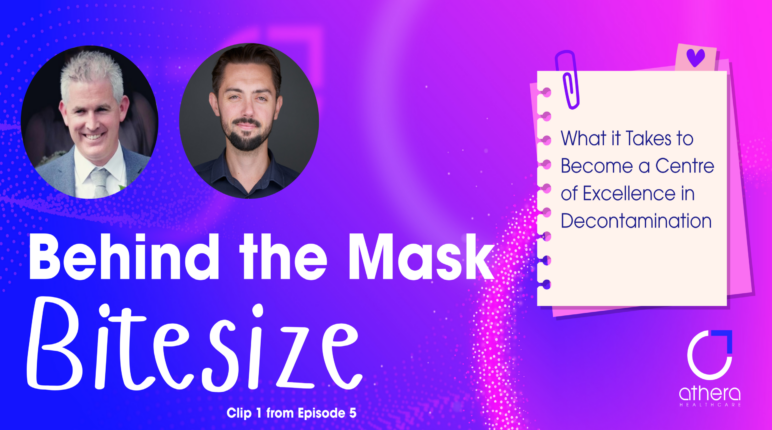
The Mater Hospital in Dublin needs little introduction in Irish healthcare. As one of the country’s largest acute teaching hospitals, with close to a thousand beds and seventeen national specialties, it operates at a scale and complexity that few institutions in Ireland can match.
What is perhaps less widely known outside the decontamination profession is that its CSSD department, under the leadership of Trevor Duffy, has quietly become one of the most respected in the world.
Professionals travel from across Europe, the Middle East, and the UAE to learn from how the Mater runs its service because it is now considered a Centre of Excellence.
What is a Centre of Excellence?
In the context of decontamination and sterile services, a Centre of Excellence is understood as a department that serves as a source of education, learning, and best practice in the reprocessing of medical devices. Some professional bodies have formalised this with assessment frameworks, where recognition is granted to departments that demonstrate consistently high standards across their full decontamination process.
In Trevor’s case, the recognition came from a manufacturer partner, based on what they observed when they visited the Mater, which were the standards of the team, the rigour of the processes, and the depth of engagement with new technology. As Trevor is careful to note, it carries no commercial dimension whatsoever.
In practice, it means that clinicians, managers, and decontamination leads from other hospitals and other countries visit to observe your workflows, to understand how you manage your instruments, and to take ideas back to their own departments. The Mater’s Centre of Excellence has been oversubscribed year after year, with visitors arriving from all over the world.
Trevor describes it as like-minded people coming together in shared learning, and he is clear that he considers it as much an opportunity for him to learn from his visitors as it is for them to learn from him.
The Origins: A Steriliser Upgrade and an Unexpected Outcome
In 2018 and 2019, the Mater decided to develop a robotic surgery programme. As part of that process, every department was asked to assess what would be required from their area to support it. For the CSSD team, their low temperature sterilisation system was ten years old and had reached end of life, meaning a significant upgrade was needed.

The department ran a tender and purchased a new low temperature steriliser that had only recently been released to the European market. The Mater were among the first hospitals in the world to implement it, along with the full ecosystem that came with it. Within six months of going live with the system, a representative from the manufacturer made contact. When the head of education visited the department, the information they shared was a testament to the way the department runs as in that short period of time, the Mater had already become the highest users of the manufacturer’s system globally.
Trevor showed them around the department, walking them through the processes, the workflows, and how the team managed medical devices with the new technology in place. The visitors were, in his words, genuinely taken aback. Shortly afterwards, the Mater was invited to become a Centre of Excellence.
Why the Data Made the Difference
It would be easy to read that story and focus on the outcomes: the COE status, the international profile, the ongoing recognition. The more instructive part, however, is understanding what produced it.
They became the highest users because they engaged fully with it from the beginning.
Trevor is frank about how his role has evolved as a result. Where once the focus was primarily operational, it has become increasingly data-driven. He is now regularly asked about productivity, sustainability, and non-conformance rates, and he has seen firsthand how that information lands when it reaches the right audiences. CEOs and financial controllers, he observes, often have very little understanding of how much work a decontamination department processes on a daily, weekly, or yearly basis. When they do encounter those numbers, it tends to come as a considerable surprise.
This is a gap that affects many decontamination departments across the NHS and HSE. The work is demanding, the standards are high, and the teams are skilled. But if that work is not being captured and communicated in a form that organisational leaders can understand and act on, the department remains largely invisible to the people who make decisions about resource, investment, and recognition.

What This Means for SSD Managers and NHS Leaders
The Mater’s journey toward a Centre of Excellence wasn’t the result of a strategy designed to produce that outcome. It was the result of a team that took seriously the value of their own data, invested in the right technology at the right time, and used what that technology showed them to improve and to communicate.
For SSD managers considering where to focus their efforts, Trevor’s experience suggests that data is worth thinking about differently. It’s not simply a tool for audit readiness or regulatory compliance, though it serves both of those purposes well. It is also a way of making a department’s contribution legible to the organisation around it, and to the wider profession. Departments that can articulate what they do, with evidence, are better placed to attract investment, to form partnerships with suppliers and innovators, and to build the kind of professional profile that creates opportunities over time.
For NHS and HSE leaders, the story offers a reminder that Centres of Excellence in decontamination do not emerge from top-down mandates, but from teams that are given the environment to work well, the tools to capture what they do, and the encouragement to share what they learn. The Mater Hospital, as Trevor describes it, promotes a culture of teaching, learning, research, and innovation. That environment is what made it possible for a routine equipment upgrade to become the foundation of something much more significant.
The recognition followed the work.
This article is part of BTM Bitesize, a series of short educational pieces drawn from Behind the Mask, Athera Healthcare’s video series on the people and practices that drive surgical and clinical excellence.
Book a Demo
Arrange a one-to-one demonstration with a member of our dedicated team. We collaborate to tailor the experience so you can see how our solutions can be applied in your specific context and utilised effectively to achieve your objectives.