Behind the Mask
The Department That Could Shut Down Your Hospital Tomorrow
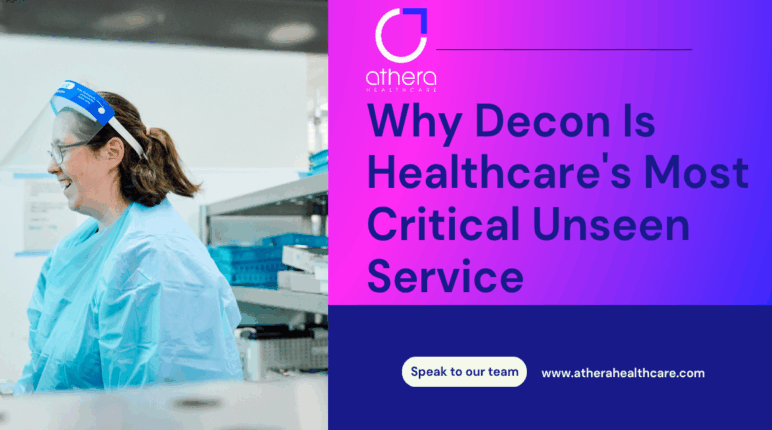
Why Decontamination Is Healthcare’s Most Critical Unseen Service
A Question Most Healthcare Leaders Can’t Answer
Here’s a question for hospital executives, clinical directors, and surgical coordinators:
If your decontamination department stopped working tomorrow, how long until surgery stops?
The answer, according to Rob Warburton, Trust Decontamination Lead at Manchester University Hospitals, is immediate.
If your decontamination unit shuts down, surgery stops. There would be no surgery in an acute trust. That is how important decontamination is to patient care.
Not slowed down. Not rescheduled. Stopped.
Yet despite this criticality, decontamination services remain one of the most misunderstood, undervalued, and overlooked functions in healthcare. When budget cuts are discussed, they’re often lumped in with “support services.” When hospital tours are given, they’re rarely included. When innovation and excellence are celebrated, they’re seldom mentioned.
This blind spot poses real risks to patient safety, operational efficiency, and clinical outcomes.
The Misconception: “They Just Wash Surgical Instruments”
Sharon Fox, Head of Decontamination at University Hospital Birmingham, has heard it countless times:
People think we’re just washing knives, forks, and spoons. They don’t realise the science behind it.
This misconception… that decontamination is a simple cleaning task – is a dangerous misunderstanding in healthcare.
Here’s what decontamination actually requires:
Chemistry expertise: Understanding how cleaning agents interact with different materials, knowing which chemicals damage which devices, and ensuring compatibility between solutions and instruments.
Microbiology knowledge: Understanding pathogens, infection risks, contamination pathways, and what level of disinfection or sterilisation is required for different device categories.
Steam science: Knowing how steam tables work, the difference between clean steam and superheated steam, and how steam penetration affects sterilisation efficacy.
Water quality management: Maintaining rigorous standards for water used in cleaning and sterilisation processes, as contaminated water undermines everything else.
Infection control principles: Applying evidence-based practices to prevent healthcare-associated infections, understanding transmission pathways, and implementing barrier controls.
Anatomy and physiology: Knowing where and how surgical instruments are used on the body, which informs the risk assessment and reprocessing requirements.
Device knowledge: Understanding the construction, materials, and functioning of literally millions of different surgical instruments across every specialty – from general surgery to ophthalmic, from orthopaedics to neurosurgery.
As Rob explains: “When you’re managing a decontamination service, you have to be a jack of all trades. You need to understand the fundamentals of each one of those specialties to be able to apply the science to decontamination.”
Compare that to the common perception of “washing dishes,” and you begin to see the problem.
The Reality: Expert Technicians Who Know More Than Surgeons
Sharon shares a story that perfectly illustrates the expertise gap:
“I can remember when I was a junior SSD supervisor, and there was a patient that needed an ALO fitted. The doctor didn’t know how to assemble it because we had to disassemble it to ensure it was washed properly. I had to run over to one of the theatres and show the consultant how to assemble this device.”
Before the consultant could object, Sharon explained: “If we didn’t do that, then it wouldn’t be cleaned and you wouldn’t be able to use it anyway.”
His response? “Oh crikey, you know stuff, don’t you?”
Yes. Yes, they do.
Here’s another way to understand the expertise required:
Scrub nurses specialise. You have a nurse for orthopaedics, a nurse for general surgery, a nurse for ophthalmics. They become absolute experts in their specific instruments.. and there are millions of instruments across healthcare.
Surgeons specialise. They know every instrument for their specific procedures, their specialty, their surgical approach.
Sterile services technicians? They know every single instrument for every single specialty.
The Consequences: When Decontamination Fails
What’s at stake when decontamination processes fail?
Patient harm: Instruments contaminated with blood, tissue, or pathogens from one patient used on another patient can transmit serious infections – including HIV, Hepatitis B and C, CJD, and antibiotic-resistant organisms.
Surgical cancellations: If instruments aren’t ready, procedures can’t proceed. Patients who’ve fasted, been admitted, and prepared for surgery are sent home. Theatre time is wasted. Waiting lists grow longer.
Regulatory action: Failures in decontamination can trigger CQC interventions, health authority investigations, and in serious cases, legal consequences.
Reputational damage: Public trust in a hospital is shaken when decontamination failures become known, even if no patients were ultimately harmed.
Financial impact: Emergency recalls of instruments, re-sterilisation requirements, extended patient stays due to infections, and litigation costs add up quickly.
Sharon is frank about the stakes: “If decontamination isn’t followed, it can critically impact the patient. This is what the IDSC is about, bringing that knowledge together to prevent that.”
The NHS has seen high-profile cases where decontamination failures resulted in patient notifications, expensive recalls, and in the worst scenarios, infections that could have been prevented.
The Blind Spot: Support Services vs. Patient Safety Enablers
Rob identifies the core problem:
“I don’t think it makes us feel bad, but we are considered the unsung heroes. The focus, rightly or wrongly, is always on the frontline staff – the clinical staff. But what people don’t realise is that without the support services, those clinical services couldn’t operate. The clue’s in the name: support services enable everything else.”
This framing… “support services”… is part of the problem.
When we label decontamination as “support,” we unconsciously deprioritise it. Support sounds nice-to-have, not mission-critical. Support sounds like something that can be cut when budgets tighten or outsourced when procurement looks for savings.
But decontamination isn’t support. It’s a patient safety enabler.
Every surgical procedure depends on it. Every infection prevented starts with it. Every successful outcome relies on it.
The language we use shapes how we value the function. And right now, the language is wrong.
The Scope Creep: Beyond Sterile Services
Sharon highlights another misconception, that decontamination is just about surgical instruments:
“Decontamination in the broad spectrum is anything within the healthcare organisation that’s getting cleaned between patient uses. It’s cleaning, disinfection, and sterilisation depending on the criticality of the device.”
This includes:
Critical devices: Surgical instruments that enter sterile tissue or the vascular system (require sterilisation)
Semi-critical devices: Endoscopes, respiratory equipment, and items that touch mucous membranes (require high-level disinfection)
Non-critical devices: Items that contact intact skin, such as blood pressure cuffs, stethoscopes, commodes (require cleaning or low-level disinfection)
In practice, decontamination leads often also oversee:
- Water quality management (legionella control, water testing)
- Linen and laundry contracts
- Medical device purchasing decisions (ensuring devices are compatible with decontamination processes)
- Infection control committees and outbreak management
- Training and competency assessments for hundreds of staff
Sharon describes the reality: “Decontamination leads go off on tangents. Rob does a lot with water. Some go into linen contracts. Any device that requires high-level disinfection has to be verified by me because procurement will buy products without realising the chemistries will either damage the product or not clean it effectively.”
The Global Context: Why the UK Leads (And What That Means)
The UK is 10 years ahead of the United States in decontamination standards.
Sharon witnessed this firsthand when she represented the UK at the World Forum for Decontamination in Chile:
“There were 600-700 people, and they all want to be like the UK. They think the UK is at the top with regards to standards, training, and development. In America, bless their cotton socks, they’re still handwashing surgical instrumentation.”
The country that invented most of the robotic surgery technology used globally is still handwashing surgical instruments in many facilities.
Why does the UK lead?
Rob offers an explanation:
“The NHS is more robustly adhering to guidance and standards because it’s publicly funded. We have to be responsible. Private industry doesn’t conform to the same rigorous quality.”
In other words, the UK’s global leadership in decontamination isn’t accidental, it’s the result of systemic investment in regulation, education, professional bodies, and a culture of accountability.
When we take that for granted, when we underfund decontamination departments or treat them as low-priority support services, we risk losing that leadership position.
And more importantly, we risk patient safety.
The Path Forward: What Healthcare Leaders Need to Do
If you’re a hospital executive, clinical director, procurement lead, or governance manager, here’s what understanding decontamination’s criticality should mean for your organisation:
1. Change the language.
Stop calling decontamination “support services.” Start calling it what it is: a patient safety function.
Language shapes budget priorities, strategic planning, and cultural value. If we want decontamination to be treated as mission-critical, we need to describe it that way.
2. Include decontamination in strategic decisions.
When you’re planning new theatre suites, purchasing new surgical equipment, implementing new procedures, or designing patient pathways, decontamination leads should be at the table from day one.
As Sharon notes: “Procurement will go out and buy a product, then realise the chemistries we use will damage it or not clean it effectively. We have to tease that out to ensure trust standards are maintained.”
Early involvement prevents expensive mistakes.
3. Recognise the expertise.
When clinical leadership publicly acknowledges decontamination teams, like Sharon’s Chief Nurse did, it sends a powerful message about values and priorities.
4. Ensure regulatory compliance isn’t an afterthought.
Decontamination operates in a heavily regulated environment.
Ensure your organisation has:
- Up-to-date policies aligned with HTM standards
- Regular audits and quality assurance processes
- Incident reporting and learning systems
- Adequate staffing to maintain standards
Cutting corners in decontamination is not where savings should be found.
6. For industry partners: Support the profession.
If your organisation manufactures or sells medical devices, decontamination chemicals, sterilization equipment, or related products, you have a role to play in supporting professional development.
Sponsoring events like the IDSC Congress, funding education initiatives, and engaging with branch meetings aren’t just marketing, they’re investments in the profession that uses your products and ensures patient safety.
Conclusion: The Unseen Heroes of Surgical Safety
Decontamination services are healthcare’s unseen linchpin.
Not because they should be unseen, but because we’ve collectively failed to shine a light on their criticality, complexity, and contribution to patient outcomes.
The professionals in these departments aren’t “just washing instruments.” They’re applying advanced scientific knowledge across multiple disciplines to ensure that every device used on every patient is safe.
They’re navigating complex regulatory frameworks, managing risks that could shut down surgical services, and preventing infections that could harm patients or trigger costly outbreaks.
And they’re doing this work – critical, complex, patient-facing work—while being labelled as “support services” and often overlooked in strategic planning, budget allocations, and professional recognition.
Rob Warburton put it simply: “If decontamination shuts down, surgery stops.”
The department that could shut down your hospital tomorrow deserves more than being taken for granted.
It deserves investment, recognition, and a seat at the leadership table.
This article draws on insights from Behind The Mask Episode 2, featuring Rob Warburton (Trust Decontamination Lead, Manchester University Hospitals & IDSC Director of Communications) and Sharon Fox (Head of Decontamination, University Hospital Birmingham & IDSC Finance Director). Watch the full conversation here.
Behind The Mask is Athera Healthcare’s monthly video series highlighting the people, partnerships, and perspectives that drive surgical excellence.
Book a Demo
Arrange a one-to-one demonstration with a member of our dedicated team. We collaborate to tailor the experience so you can see how our solutions can be applied in your specific context and utilised effectively to achieve your objectives.