Our Shared Learning Series: Kit Availability as a Patient Safety Imperative

Alex Prior, Head of Sales
Our shared learning series is exactly what it says in the title! We have a wealth of knowledge that we’ve gained from working with so many amazing trusts across the UK and Ireland, and we want to share our biggest learnings and takeaways from their successes.
Kit Availability as a Patient Safety Imperative: Why Decontamination Data Must Drive Surgical Scheduling
Track and trace is widely understood as a compliance necessity.
It satisfies audit requirements, supports recalls, and provides the documentation trail that regulators expect. For many departments, that is where its function begins and ends.
But this framing undersells it considerably.
When traceability data is actively owned and used by decontamination teams, it becomes a source of operational insight that directly supports patient outcomes, including the availability of kit for surgical lists.
So the question worth asking is not whether your department has a track and trace system, but rather whether you are getting full operational value from the data that traceability generates.
If you’re not sure, this is exactly what this article is for. We aim to take you through why and how kit availability data will help hit your patient safety objectives.
Why Kit Availability is a Patient Safety Issue
The connection between instrument availability and patient outcomes is direct. A procedure delayed or cancelled because the correct kit cannot be confirmed as processed and ready represents a failure in the care pathway – one that originates not in the theatre but in the systems and processes that support decontamination.
Decontamination teams are acutely aware of this pressure. At Medway Maritime Hospital, Endoscopy Decontamination Manager Christopher Eden leads a team of seven technicians processing high volumes of sensitive endoscopic equipment under continuous demand. Urgent requests arrive without warning. Equipment must be confirmed as safe and available with little margin for delay. As Eden describes it, “no is not an option.” The expectation of consistent kit availability, regardless of staffing levels or throughput, is absolute.
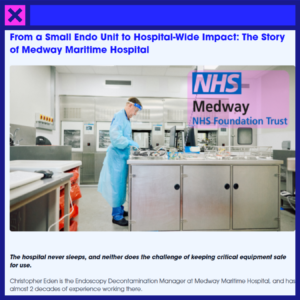
This is the operational reality that traceability systems must support. When they do not, the consequences are felt first by patients.
Where the Gaps Commonly Arise
Understanding kit availability as a patient safety issue requires understanding where traceability commonly falls short. There are two recurring failure points worth examining:
The first is retrospective data capture.
In departments relying on manual or partially manual recording systems, processing data is compiled at the end of a shift rather than captured at the point of action.
At Hampshire Hospitals NHS Foundation Trust, Decontamination Lead Abdul Youssef managed decontamination across 3 sites under exactly these conditions prior to implementing digital traceability. All data had to be manually entered at the end of each working day, a process that consumed up to 2 hours of staff time daily. During busy periods or when staffing was reduced, the pressure this created was significant. As Youssef recalls: “Before, if we had a busy day or staff sickness, I would panic because the paperwork still had to be done.”

The practical consequence of retrospective recording is that instrument status is unknown in real time. A tray cannot be confirmed as processed until the data has been entered. That lag, however brief, is operationally meaningful when a theatre coordinator needs to confirm kit readiness before a list begins.
The second failure point is the visibility gap at dispatch.
Across many NHS decontamination departments, the most common endpoint of track and trace recording is the point at which equipment leaves the department.
Once dispatched:
- instruments become invisible to the system
- Stores locations are not updated
- Theatre teams cannot confirm receipt or readiness without making a phone call
- and Decontamination managers have no mechanism to confirm that their output reached the intended destination safely and on time.
This gap matters because it creates scheduling uncertainty downstream. Theatre coordinators working without confirmed kit availability data must either build cautious assumptions into their lists, reducing utilisation, or proceed on the assumption that equipment will be ready and manage the consequences when it is not.
What Good Should Look Like
Addressing kit availability as a patient safety concern requires traceability to function in two ways that are often underdeveloped: real-time data capture and extended visibility beyond the decontamination department.
Real-time capture means that instrument status is recorded at the point of action, through barcode scan or machine integration, rather than retrospectively.
At Hampshire Hospitals, implementing this approach delivered a 50% reduction in recording and tracking time and a 30% improvement in instrument turnaround time. Staff were freed from end-of-shift data entry, reducing both the administrative burden and the anxiety associated with it. Crucially, instrument status became confirmable in real time, providing the certainty that scheduling decisions require.
Extended visibility means introducing scanning control points beyond dispatch:
- in stores
- at theatre receipt
- and at the point of issue
so that instrument location and status remain visible across the full care pathway.
At Medway Maritime Hospital, this principle shaped a significant expansion of the Trust’s traceability system. What began as a departmental solution for the endoscopy unit was progressively extended to cover theatres, ENT, day surgery procedure suites, and the Trust’s mobile endoscopy unit. The rationale was straightforward: “We often need to swap and share inventory, so this has given us that wide view that’s critical for us to do just that.”
With that wide view in place, theatre coordinators can confirm kit availability before finalising lists, identify potential shortfalls with sufficient lead time, and reduce the volume of reactive fast-track requests that place additional pressure on reprocessing teams.
Questions You Should be Thinking About
For decontamination managers and endoscopy reprocessing leads reviewing their own practice, three questions are worth considering.
- At what point in the instrument lifecycle does your traceability data become invisible to theatre and clinical teams? If the answer is dispatch, the visibility gap is structural and warrants review.
- Is processing data captured in real time at the point of action, or compiled retrospectively? The interval between the two is the period during which instrument status cannot be confirmed.
- What connections exist between your traceability system and the systems used by theatre coordinators or stores teams? Without those connections, decontamination data remains a departmental record rather than an input into scheduling decisions.
Alex Prior is our Athera Healthcare Head of Sales and has worked with trusts across the UK and Ireland to improve surgical workflows.
Book a Demo
Arrange a one-to-one demonstration with a member of our dedicated team. We collaborate to tailor the experience so you can see how our solutions can be applied in your specific context and utilised effectively to achieve your objectives.