Athera News
Behind the Mask
Clinical outcomes
How 7,000 Cases Reshaped Maternal Care
What does it take to transform maternal care across an entire region?
It’s not mandates from above, or expensive technology alone, but thousands of small acts of dedication by staff who believed the work mattered.
This is the story of the Maternal Enhanced and Critical Care Project in Yorkshire and the Humber, and what happens when healthcare professionals put data at the forefront of clinical care.
Watch the Full Episode
Episode Length: 57 minutes
Featured Guests: Dr. Deborah Horner (Bradford Teaching Hospitals NHS FT) and Viv Dolby (Lead Midwife for MEaCC)
What is MEaCC?
Maternal Enhanced and Critical Care (MEaCC) is a regional initiative across Yorkshire and Humber supporting the approximately one in ten women who become critically unwell during or after pregnancy. Through coordinated data collection, multidisciplinary training, and shared policies across 17 maternity units and counting, MEaCC helps staff recognise deterioration early and deliver the right care at the right time. As of now, they have 7,000+ cases on the system.
“Every single one of those 7,000 cases has been manually data entered by a member of staff in those individual trusts,” Dr. Deborah Horner explains. “That is hours and hours of people’s time, which if they didn’t want to do it or see the importance just wouldn’t have happened.”
And this isn’t data entry for compliance; it is an initiative created by staff with the sole focus of improving clinical outcomes. The initiatives success has led the data findings to inform national guidelines.
“Once we started to collect the data in each of the individual units, we were then able to start to understand a bit more about why those women become unwell and how many do,” Dr. Horner says. “Roughly speaking, it’s about 10% of women – any women who are booked in any unit will become unwell enough to need enhanced maternal care.”
Without that data, collected case by case across the region by dedicated midwives, those patterns would remain invisible.
Building During COVID
If the achievement is impressive, the timing makes it extraordinary!
“We started the data collection during COVID – what a time to do that,” Viv Dolby, Lead Midwife for MEaCC, recalls with a laugh. “And everybody has been on board. Every single trust has been on board.”
During a global pandemic when healthcare staff were stretched beyond breaking point, that’s when Yorkshire and Humber’s maternity units chose to invest in building something better.
“It’s been a wonderful collaboration to be part of,” Viv continues. “Everybody has worked together and that’s what I love. It’s the team looking to work together to improve care for women.”

MEaCC at their Annual Conference 2025
It all Started with Honesty
“My journey started as a new consultant coming in,” Dr. Horner recalls, “and one of the at-the-time quite junior midwives coming up to me and very directly saying ‘I have absolutely no idea what I’m doing with looking after sick women. Can you please do something to help us do this better?'”
That vulnerability and willingness to admit “I don’t know” and ask for help became the catalyst for regional transformation.
Culture shifts when staff feel safe enough to be honest about gaps in knowledge or resources, and when leadership responds not with judgment but with action.
What started with one conversation grew into multidisciplinary steering groups across 17 trusts, training programmes, shared policies, and a data collection system that now holds 7,000 cases. Data is the evidence needed for progress.
“It Is Absolutely a Team Sport”
Central to MEaCC’s success is a fundamental understanding that collaboration is key.
“A midwife has loads of skills that are really important for looking after a woman who is having a baby,” Dr. Horner explains. “A critical care nurse has loads of skills in looking after really sick women. Anesthetists, obstetricians, neonatologists – they all have specific skill sets. There will never be a situation where one person can do everything. It is absolutely a team sport.”
This is embedded in how MEaCC works:
- Multidisciplinary steering groups in every trust
- Shared training across professions
- Policies that define when and how to escalate care
- Data that belongs to everyone, informing care across boundaries
Collaborative progress means achieving better outcomes than any single profession could deliver alone.
When Excellence Becomes “Just How We Do It”
For Dr. Horner, there’s one moment that makes all the work worthwhile.
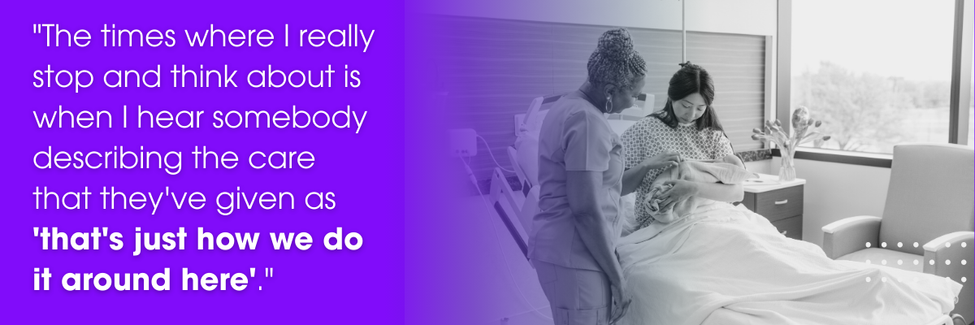
“The times where I really – it kind of makes me stop and think about it – is when either in my own unit or in someone else’s unit I hear somebody describing the care that they’ve given as ‘that’s just how we do it around here’ and knowing that that is the work that we have been doing for the last 10 years and that it has become embedded as normal practice.”
What Made MEaCC Work
Looking at MEaCC’s success, several key factors emerge:
- Start with staff needs: The project began by listening to what frontline staff needed. After all, they’re the experts!
- Make it practical: The data collection system was designed to be as user-friendly as possible for busy clinical staff
- Build buy-in at every level: From shop floor to senior management, everyone understood why this mattered
- Share ownership: This was never a one trust initiative, this was about changing clinical outcomes for women and babies, so it belonged to everyone
- Celebrate the work: Acknowledging the hours of staff time invested, and being “hugely grateful to everyone who’s been involved”
- Focus on outcomes: Always keeping the focus on improving care for the one in ten women who become critically unwell
Join the Project!
The policies developed in Yorkshire and Humber are now being adapted nationally. The model is there for other regions to follow, so the invitation is to join is open!
Why This Story Matters
At Athera, we’re passionate about shining a light on the people and partnerships that drive clinical excellence. MEaCC’s story is a powerful reminder that transformation doesn’t always come from expensive technology or top-down mandates, but from collaboration between teams to share data, knowledge, and outcomes.
About Behind The Mask
Behind The Mask is Athera Healthcare’s podcast series highlighting the people, partnerships, and perspectives that drive surgical and clinical excellence. Each episode goes beyond technology to uncover the roles and relationships critical to delivering better patient outcomes.
Book a Demo
Arrange a one-to-one demonstration with a member of our dedicated team. We collaborate to tailor the experience so you can see how our solutions can be applied in your specific context and utilised effectively to achieve your objectives.