Athera News
Behind the Mask
Why the Best People Supporting Decontamination Teams Never Really Left the Profession
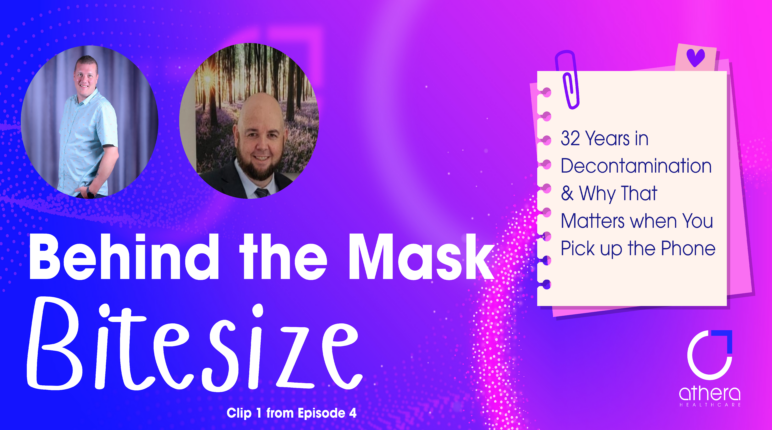
Every time Wayne Davy meets a new decon team, he sees the relief that comes across their face once he tells them he was in their shoes for 17 years before becoming Athera’s Customer Success Manager. “When I tell them I’ve got the experience, they always relax a bit. They know you’re there. You know what they’ve been through.”
Wayne Davy joined NHS Scottish Borders as a decontamination technician and worked his way up through the ranks across his 17 year tenure. By the end he had been senior management, waste manager, water safety manager, and quality manager.
Wayne and his colleague Shane Corbett, who spent a decade at Temple Street Children’s Hospital and several years at Wexford General, are now Customer Success Managers at Athera Healthcare. Between them they bring thirty-two years of hands-on decontamination experience to roles that are firmly on the technology side of the industry.
Neither of them trained in healthcare technology.
And that, as it turns out, is precisely why they were hired to support it.
The Gap That Most Health Technology Companies Don’t Talk About
The market for health technology is growing quickly, and the teams that support its adoption into clinical environments are expanding with it.
What tends to grow more slowly is the depth of understanding those teams have of the environments they are selling into.
Decontamination is a specialist field and the work is technically demanding, the standards are exacting, and the consequences of a disrupted department ripple outward into theatres, patient lists, and surgical outcomes in ways that are not always visible to people who have not worked in one.
When a system issue arises in a busy CSSD, the decision about how urgently it needs to be addressed depends entirely on understanding what that department is dealing with at that moment; a support desk that has never experienced instrument flow under pressure, or managed a theatre list with insufficient turnaround time, or processed a loan kit that arrived late, will make different prioritisation decisions to one that has.
Shane is straightforward about this: Patient safety, he says, “is instilled in you from the first day you set foot in sterile services”. It becomes the lens through which you evaluate everything.
“It can be hard for a person behind a service desk to understand that something that may seem trivial is actually very important.” The flow of instruments through a department, he explains, is carefully managed, and any interruption to it, however minor it appears from the outside, “can have a huge effect on the day-to-day of a department.”
When technology companies hire people without that background, that lens can gradually go missing.
Translating Between Two Very Different Languages
“Part of the role is translating English into English.” explains Shane.
On one side of any support conversation sits the language of a technology platform, including things like system behaviour, error codes, configuration settings, database logic. On the other sits the language of a decontamination department: sets, cycles, tray configurations, wash loads, the daily rhythm of instruments moving from dirty to clean. In the absence of someone who genuinely speaks both, the gap between them becomes a source of friction that slows everything down.
Having clinical experience doesn’t just give Wayne and Shane the vocabulary, but it gives them the ability to hear what a customer is describing in operational terms and understand immediately what it means in practice, meaning they know what’s a priority and how to shape both the product and the support to suit the real needs of the customer.
Why This Matters When a Department Is Going Through Digital Change
The period around a new technology implementation is when the quality of customer support is most consequential.
As teams are learning new systems, what they need from the people supporting those systems goes beyond just technical accuracy, but is about the reassurance gained from knowing that the company you’re working with truly understands what you’re going through. Wayne says: “It’s important to let the customer know you’re there for them as much as possible.”
Shane talks about the particular importance of the early period with a new customer. It is not just about additional contact, though that matters. It is about building trust, and trust in this context means something specific. It means the customer feeling that their CSM understands their environment well enough to advocate for them within the technology company, to translate their operational concerns accurately, and to make sure that what might seem like a minor technical issue is treated with the seriousness it deserves.
That last point is one that both Wayne and Shane return to. The flow of instruments through a decontamination department is carefully managed, and even a small interruption to it can have consequences that are disproportionate to how the issue presents on a support ticket. Knowing that, and being able to communicate it to a technical team that is looking at a log file rather than a department, is a form of expertise that takes years of working in decon to develop.
What Athera Chose to Do About It (and how that affects you)
When Athera recruited for their customer success function, the brief was deliberately specific as they wanted people who had worked in decontamination. “They said we can teach you how to be a CSM, but we can’t teach your experience. That was the main reason. They specifically picked people with the experience because they want the customers to know that they get it.”
There is a broader point here that applies beyond Athera. Health technology companies that invest in people with genuine clinical experience in their customer-facing roles are not just making a service quality decision. They are making a signal to the market about what they believe matters.
Decon teams deserve companies that don’t just provide a product, but who actually invest in understanding the industry. That intention is what sets healthtech firms apart.
This article is part of BTM Bitesize, a series of short educational pieces drawn from Behind the Mask, Athera Healthcare’s video series on the people and practices that drive surgical and clinical excellence. Watch Episode 4 here:
Book a Demo
Arrange a one-to-one demonstration with a member of our dedicated team. We collaborate to tailor the experience so you can see how our solutions can be applied in your specific context and utilised effectively to achieve your objectives.