Athera News
When Your Customer Success Manager Has Done Your Job: Read Wayne and Shane’s Story
Wayne Davy joined NHS Scottish Borders as a decontamination technician and worked his way up through the ranks. By the end, he was wearing multiple hats: senior management, waste manager, water safety manager, quality manager.
He’d done community-based decontamination across dental, sexual health, and podiatry services. He knew the work inside out.
“I kind of felt like I’d peaked where I was,” Wayne says. “Unless I wanted to go and do a master’s in management or something, which I didn’t really fancy doing or being able to fund at the time.”
Shane Corbett’s path was different but similar. After studying at university, he started in decontamination at Temple Street Pediatric Children’s Hospital in Dublin. He spent 10 years there, then moved to Wexford General Hospital for another five.
Over 15 years, Shane went through two complete Athera Fingerprint system implementations. He watched his departments transform from manual, paper-based tracking to full electronic traceability.
“I was lucky enough over both sites to go through two Fingerprint implementations,” Shane reflects. “Seeing the difference between manual systems and electronic traceability gives you a great insight into what the system actually does.”
Both eventually moved into Customer Success roles at Athera Healthcare.
They didn’t leave decontamination behind. They just moved to a completely different side of it!
The Problems They Remember are Problems They Now Help Solve
The pressure in the pack room
Wayne remembers the concentration it took. “These units are sometimes extremely busy, and the concentration required to do that job, especially in the pack room—if the system’s not performing how you need it to, it can impact so much.”
Shane talks about flow. In sterile services, instruments move through the department in a specific sequence: dirty to clean, one module to the next.
“Any interruption to the flow, however minor it may seem, can have a huge effect on the day-to-day of a department,” Shane explains.
When small problems become big ones
From the floor, you know which issues are actually urgent and which ones can wait. A service desk looking at a ticket doesn’t always see that difference.
“It can often be hard for a person behind a service desk to understand that something that may seem trivial is actually very important,” Shane says.
Wayne puts it plainly: “The smallest little thing can cause such a big issue.”
That gap- between what looks minor on a screen and what actually disrupts a department—is something you only understand if you’ve worked the floor.

What Changed When They Moved to Customer Success
Translating Between Two Worlds
“We get screenshots of error messages that come up on desktops, and I don’t know what they mean,” Wayne admits. “I’m like, let’s get your tech team and our tech team to talk, because it’s just jargon to me.”
But when it comes to understanding how an issue affects workflow? Wayne and Shane get it immediately.
Shane describes it as “translating English into English.” Technical teams speak one language. Clinical teams speak another. Both are English, but they mean different things.
“You get the technical language from the tech side, and the more practical, process-driven language from customers,” Shane says. “Sometimes you just need to translate from one to the other.”
“It’s about us being able to translate that across to the support team and say, look, it might sound small, but this is massive for them. Can we prioritise it?”
How Customers Respond
Wayne starts every training session the same way.
“My name is Wayne Davy. 17 years in decontamination with NHS Scottish Borders.”
During one session, a customer stood up and shook his hand. “She was like, ‘Well done for doing 17 years,'” Wayne recalls. “Then she followed it up with, ‘But well done for getting out!'”
He laughs about it. But what happened next was more important.
“They relax when they know you’ve got that experience. You’re not just anybody who knows the product. You know what they’re experiencing too.”
Shane sees it play out differently. For him, it’s about who customers call when they have questions.
“That’s one of the marks of how you’re doing- if the customer trusts you enough to be the first person to ring when they have an inquiry,” Shane says.
Not for technical support. But when they want to ask about industry trends, or reporting strategies, or just talk something through.
“You feel good that you’re the one they rang.”
Shaping Product Development: the unique advantage Athera Healthcare has
“We get asked quite a lot [from the Athera team]: what’s this like? Explain this part of the process to us. Why is this such a big issue?” Wayne says.
When the development team hears his explanation, things click!
“They realise, ‘Oh actually, yeah, this is quite a big thing.'”
The impact shows up in the product. “There’s been a few things that customers have fed back to me, which I experienced as a customer myself, that I’ve been able to go back to the development team and say, ‘Look, this is something we need,'” Wayne explains. “We’ve got a couple of suggestions now in test in the latest version.”
Shane was one of the first people at Athera who’d actually used Fingerprint in a live clinical setting. “As much as what I learned from my previous job was able to help customers, it was also helpful to the team here.”

Understanding What Actually Matters
When Wayne was recruited, Athera made clear that they were specifically looking for someone from decontamination.
“I was told, ‘We can teach you how to be a CSM, but we can’t teach that experience,'” Wayne says.
That experience means understanding what drives everything in sterile services.
“When I started in sterile services, patient safety was drummed into you from the beginning,” Shane reflects. “It’s the ultimate aim. It can be easy to forget that if you’re behind the desk in a tech company.”
Wayne and Shane haven’t forgotten.
“I didn’t feel like I was ready to leave decontamination,” Wayne says. “I think it’s one of those jobs that once you’re in, you’re kind of in. I still feel like I’m doing my bit for patient safety, just in a totally different sector now.”
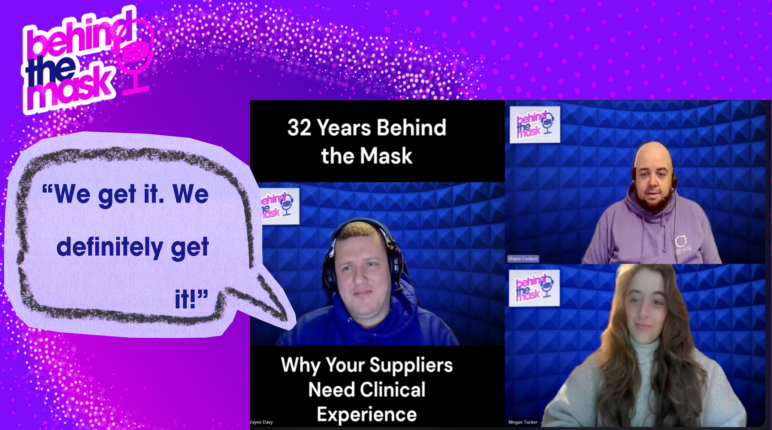
Watch Wayne and Shane’s full conversation on Behind the Mask Episode 4
Hear more about their journey from the pack room to customer success, and why clinical experience matters when choosing who supports your systems.
[Watch Episode 4]
Book a Demo
Arrange a one-to-one demonstration with a member of our dedicated team. We collaborate to tailor the experience so you can see how our solutions can be applied in your specific context and utilised effectively to achieve your objectives.